On Shorts, Reels, and TikTok, the first three seconds decide everything. A viewer who does not understand why they should keep watching swipes away, and the algorithm notices. A strong hook is not clickbait. It is a promise, made fast, that the next thirty seconds are worth their time. These five formulas work across niches, and each one takes only a sentence to write.
1. The direct question
Ask the exact question your viewer is already thinking. "Why do your Shorts stop at 200 views?" beats "In this video I will talk about Shorts growth" because it names the viewer's problem in the first second. The rule is simple: if the question does not make your target viewer think "that is me," rewrite it until it does.
2. The bold claim
State a surprising result or opinion up front, then prove it in the clip. "I doubled my views by changing only the first three seconds" works because it promises a specific payoff. Keep the claim honest and provable in the video itself. A claim you cannot back up in thirty seconds will cost you trust and watch time.
3. The pattern interrupt
Open with something the viewer does not expect: an unusual visual, a sound, or a statement that breaks the pattern of their feed. A clip that starts mid-action, with movement already on screen, holds attention better than a clip that starts with a static greeting. Cut the "hey guys, welcome back" entirely. Start on the interesting part.
4. The before and after
Show the result first, then explain how you got there. "This clip got 100,000 views. Here is the first version that flopped" creates a gap the viewer wants closed. This formula works well for tutorials, edits, and transformations of any kind, because the viewer already knows the payoff is real.
5. The curiosity gap
Reveal just enough to make the viewer need the rest. "The one setting most creators never touch" works because it implies hidden knowledge without giving it away. The gap must be real, though. If the payoff is weak, viewers learn to skip your hooks next time.
How to test hooks without extra editing
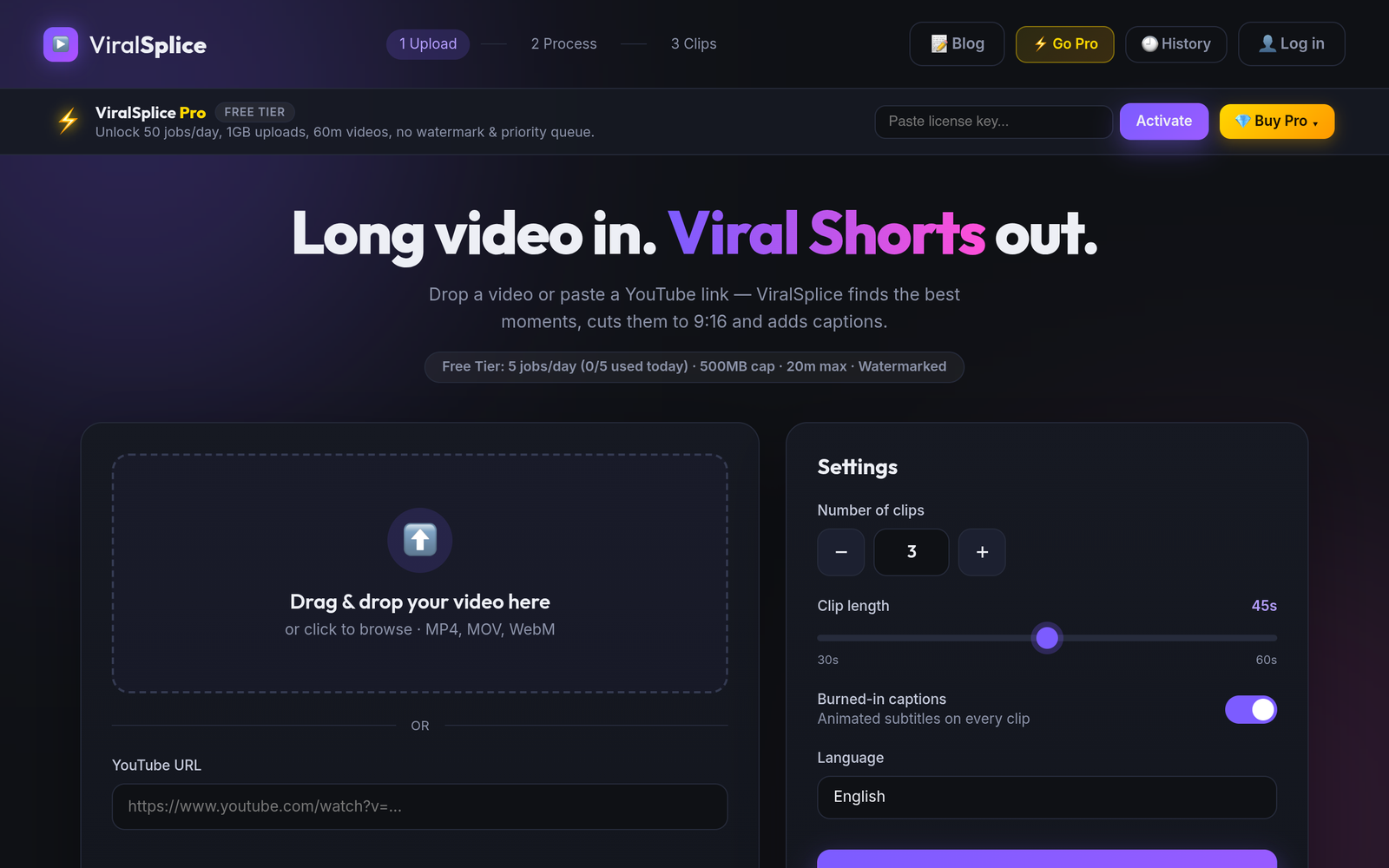
The fastest way to find a winning hook is to test several from the same long video. Cut three or four clips from one recording, give each a different opening from the formulas above, and post them on different days. Watch which one holds viewers past the first three seconds, then reuse that formula for your next batch. ViralSplice makes this easy because one upload produces several clips with burned-in captions, so the testing costs minutes, not hours.
Common hook mistakes
Three mistakes kill otherwise good clips. First, a slow intro: logos, greetings, and throat-clearing belong nowhere in a Short. Second, a vague promise: "this is amazing" says nothing, while a specific claim says everything. Third, a mismatch: if the hook promises one thing and the clip delivers another, viewers leave and the algorithm learns not to push your next video. Match the hook to the payoff, every time.
Pick one formula from this list and use it on your next Short. Then test a second formula on the same video and compare the results. If you want to cut those test clips fast, try ViralSplice free at slice.coderao.com and turn one long video into several hook variations today.